From Demo to Reality: What It Takes to Build Reliable AI Agents in Retail

When AI Gets It Wrong, Your Customer Doesn’t Come Back

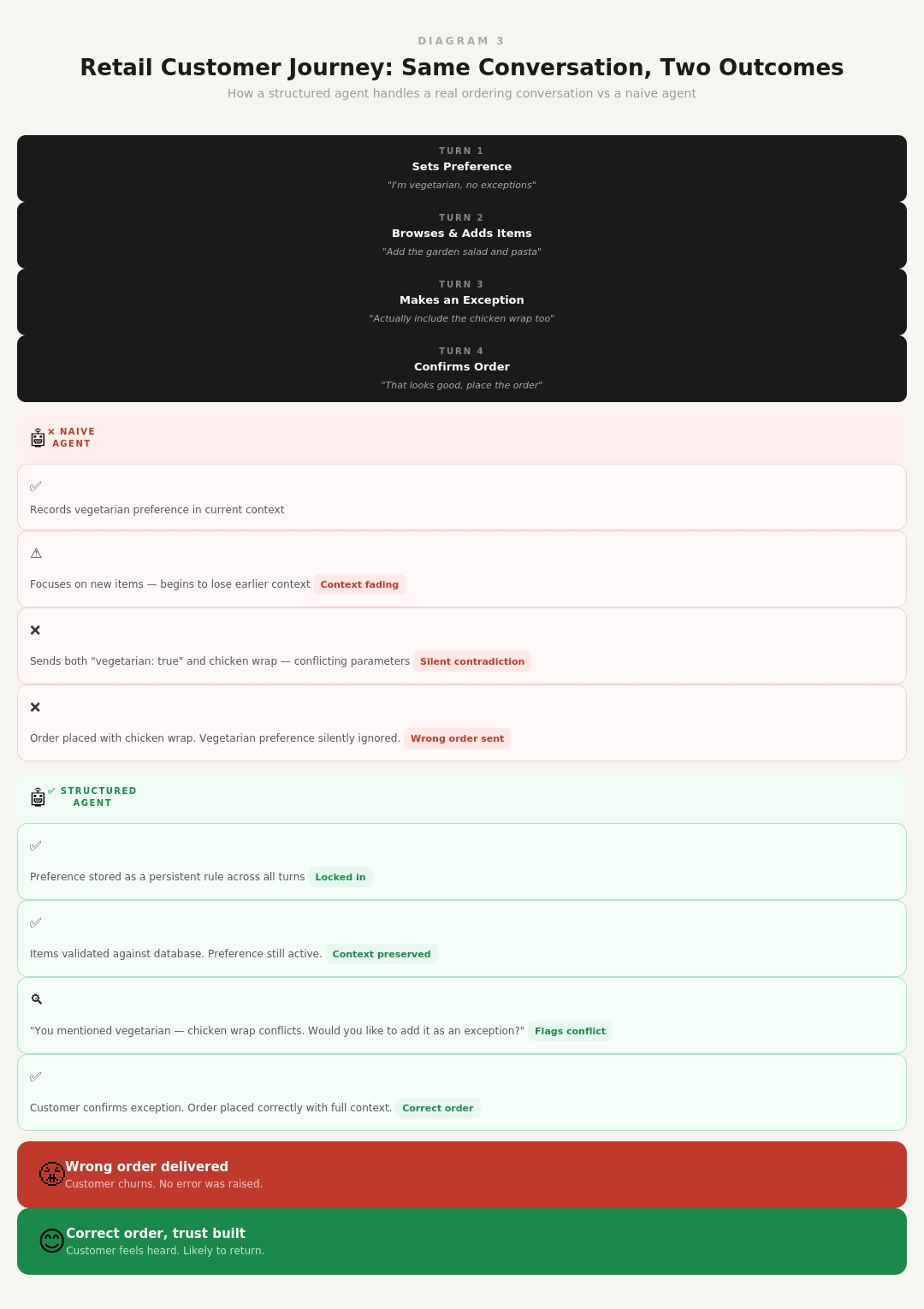
A customer opens your retail app and starts chatting with your AI ordering assistant. They mention upfront — “I’m vegetarian, no exceptions.” A few messages later, they’re browsing, adding items, refining their order. The conversation flows naturally.

Then their order arrives. It contains meat.

The AI remembered their last item selection. It forgot their dietary restriction. No error was raised. No warning was shown. The system worked exactly as designed — and still got it completely wrong.

That customer doesn’t call support. They don’t complain. They just don’t come back.

This is not a hypothetical. It is a pattern 1CloudHub observed repeatedly while building a production agentic AI system for a retail client. It is also one of the most dangerous failure modes in retail AI — not because it is dramatic, but because it is invisible. It does not show up in your error logs. It shows up in your retention numbers, three months later, when you cannot explain why repeat orders have declined.
Agentic AI in Retail Isn’t Coming — It’s Already Here

Your competitors are not waiting for a perfect moment to deploy agentic AI. They are deploying now, learning fast, and building customer loyalty that compounds with every interaction. The window to lead this shift in retail is open — but it is not open indefinitely.

Unlike basic chatbots that answer questions, agentic AI systems take actions — they remember customer preferences across a conversation, guide purchasing decisions in real time, handle complex multi-step orders, and personalise every interaction without adding headcount. For a retail CXO, that is not a technology story. That is a margin, retention, and revenue story.

The business case is already decided. What remains is execution — and execution is where most retail AI initiatives fall short:

Higher conversion — An agent that understands what a customer actually wants — not just what they typed — closes more sales and reduces cart abandonment

Lower operational cost — Fewer wrong orders, returns, and support escalations directly reduces cost-to-serve without touching your team size

Scalable personalisation — Every customer gets a tailored experience at any hour — something no human support team can match at scale

Customer loyalty that compounds — Retailers who get this right now are building a customer experience moat that becomes harder to close the longer competitors wait

The question is no longer whether to adopt agentic AI in retail — it’s whether your implementation will actually hold up when real customers use it at scale.

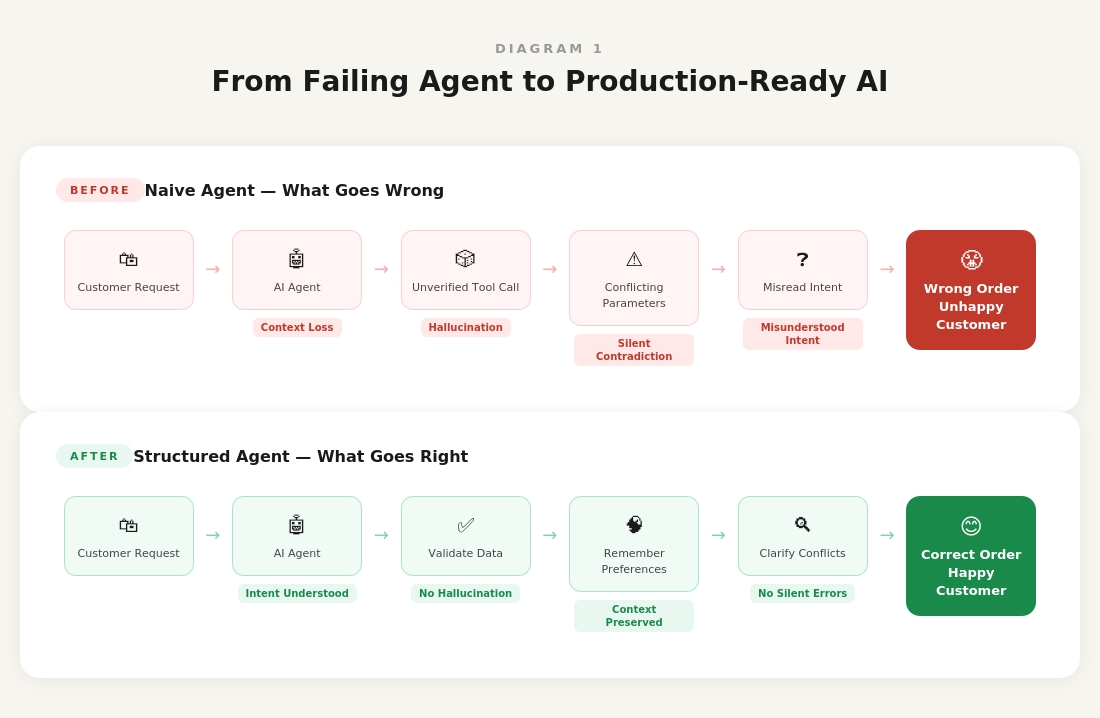
Figure 1: How a basic agent fails vs how a structured agent handles the same customer request

What Goes Wrong When Real Customers Use Your AI

When 1CloudHub built a production agentic AI system for a retail client, we did not encounter the failures that show up in code reviews or QA cycles. We encountered the ones that show up in churn reports — silent, invisible, and by the time you notice them, already costly. Four patterns emerged consistently once real customers started using the system at scale.

Each one passed every demo. Each one failed in production. And each one carries a direct business cost that does not appear in your AI vendor’s dashboard:

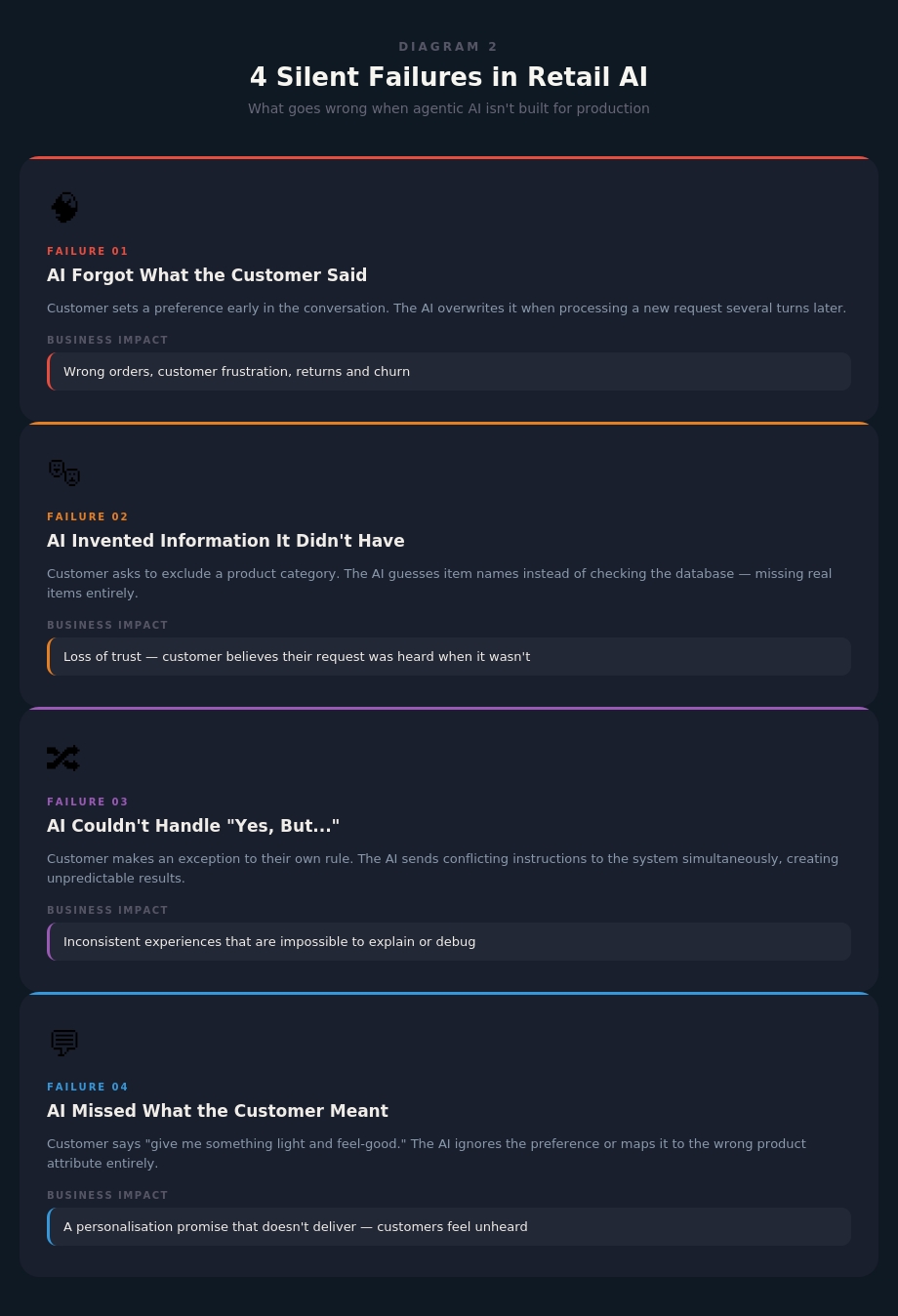
Preference amnesia — The AI forgets a constraint the customer stated earlier in the conversation. The order is wrong. The customer does not call to complain. They simply do not reorder. Business cost: silent churn with no support ticket to trace it back to.

Unverified assumptions — The AI acts on a product it believes exists, but has not confirmed against the actual catalogue. The customer receives something different from what they ordered, or nothing at all. Business cost: fulfilment errors, returns, and damaged brand trust.

Silent conflict resolution — When a customer contradicts themselves mid-conversation, the AI silently picks one instruction and discards the other. No flag is raised. No clarification is sought. Business cost: the customer gets what the AI chose, not what they wanted — and often does not understand why.

Language lost in translation — Customers use natural, everyday language — “something light,” “feel-good,” “nothing too heavy.” The AI does not map this to product parameters, so it either returns irrelevant results or nothing at all. Business cost: a broken experience that makes your AI feel less capable than a basic search bar.

Figure 2: The four production failure patterns we observed — and their business impact

How 1CloudHub Engineered the Fix

Identifying these failure patterns early, the 1CloudHub team did not reach for a different AI model. We redesigned the system architecture around one non-negotiable principle: the AI must never act on information it has not verified. Every engineering decision flowed from that.

Here is what a basic agent does versus what the structured system we built does — and why each difference matters to the business:

Challenge Basic Agent 1CloudHub Structured Agent
Customer Preferences Overwritten or forgotten as conversation progresses. Silent wrong orders. Explicitly persisted and carried forward into every subsequent action throughout the conversation.
Product Validation Acts on assumed product availability. Fulfilment errors follow. Every action is verified against the live product catalogue before execution. No guessing.
Contradictions Silently picks one instruction, discards the other. Customer gets the wrong outcome with no explanation. Flags the conflict, presents the customer with a clear choice, and waits for confirmation before proceeding.
Natural Language Cannot interpret vague language like “something light” or “feel-good.” Returns irrelevant results or fails silently. Everyday retail language is mapped to structured parameters so the AI understands intent, not just literal input.

The result was a system that behaves the way a well-trained human sales assistant would — remembering context, catching inconsistencies, and asking when unsure rather than guessing. That is not a model capability. That is an engineering decision.

Figure 3: The same ordering conversation — two very different outcomes

From Production Failure to Production Trust

Once the structured architecture was in place, the contrast was immediate — and it showed up exactly where it matters to a retail business: in what customers received, how they experienced the interaction, and whether they came back.

Orders reflected what customers actually asked for — preferences stated at any point in the conversation were honoured throughout. The wrong order problem — the one that drives silent churn — was eliminated.

Contradictions became conversations, not failures — when customers sent conflicting signals, the AI guided them to a clear resolution. The experience felt attentive. It strengthened trust rather than eroding it.

Zero silent failures in production — every action the AI took was grounded in verified information. The invisible errors that had been slipping through undetected were gone — along with the returns and escalations they generated.

The AI felt like a person who knew the customer — natural language produced relevant, personalised results. Customers were not working around the AI. They were working with it.

For the retail client, this translated directly into fewer order errors, reduced support escalations, and an AI experience that earned repeat engagement — not just initial curiosity.

The shift was not about using a smarter AI model. It was about building a smarter, more disciplined system around it. That is a distinction most AI vendors will not tell you — but it is the one that determines whether your deployment succeeds.

The Retailers Who Get This Right Will Pull Ahead

Agentic AI in retail is no longer a future investment. Customers are interacting with these systems today — forming opinions about your brand based on every exchange, every recommendation, every order that arrives correctly or does not.

The gap between AI that performs in a demo and AI that earns customer trust in production is not a model gap. It is a systems and engineering gap — one that requires hard-won experience building and running these systems in real production environments, not just prototyping them in controlled conditions.

Every week that passes without a reliable, production-grade agentic AI in your retail environment is a week your competitors are using to build customer loyalty you will have to work harder to win back. The retailers who invest in getting this right now — consistent preferences, zero silent failures, experiences that feel genuinely personal — are building a retention advantage that compounds quietly and becomes very difficult to close.

This is the work 1CloudHub does. Not just deploying AI, but engineering it to work reliably — the way your customers expect, and the way your business depends on.

Closing Reflection

Agentic AI in retail is no longer just about automation — it is about delivering consistent, reliable experiences at scale.

When AI fails silently, it doesn’t just impact operations; it erodes customer trust.The real challenge is not deploying AI, but engineering it to work accurately in real-world conditions — where every interaction matters.The retailers who get this right will build stronger trust, higher retention, and a lasting competitive edge.

Ready to build production-grade AI that your customers can rely on? Contact us today

Date: 19/03/2026  :   Written by –

Rajeev M.S

Rajeev M.S

GenAI Architect

Umashankar N

Umashankar N

Chief Technology Advisor

In Blog
Subscribe to our Newsletter1CloudHub